Evaluating a Classic School Icon Design for Real Embroidery
Sitting down to review a new design before it ever touches fabric is a ritual. You’re looking not just at lines, but at potential. When I opened the School Icons Black White Flat Design, my first thought was less about its category – Illustrations, Graphics – and more about its mood. This is a clean, crisp, and quietly cheerful set. It doesn’t shout; it communicates with a confident simplicity that promises clarity when stitched.
The Personality on the Screen vs. The Personality on the Fabric
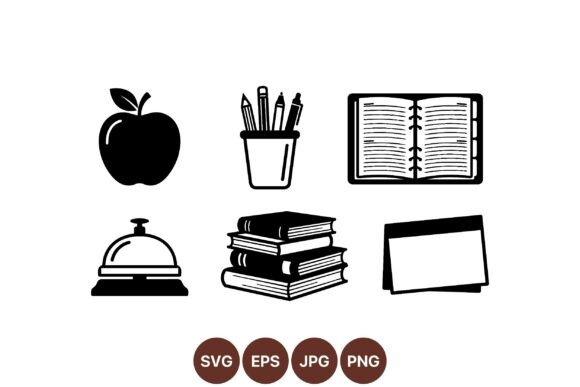
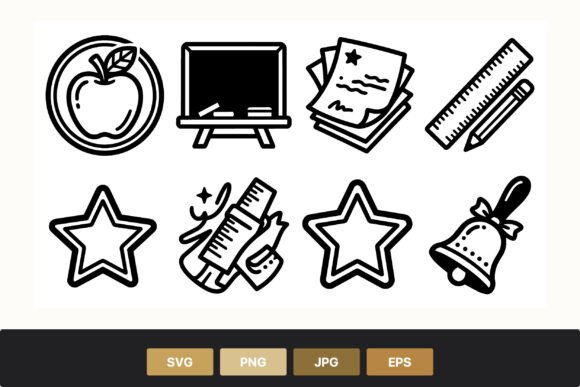
Let’s talk about that first impression. The icons – the apple on plate, the chalkboard, the stack of papers, the ruler, those outlined stars, the rolled paper with sparkles, and the bell – all share a cohesive, modern flat aesthetic. The shapes are well-defined, with thoughtful negative space. This isn’t a cluttered, overly detailed graphic; it’s a series of clear symbols. For an embroidery designer, that translates to a design that won’t lose its character when converted to stitches. The visual personality is professional yet friendly, making it feel versatile for both a playful baby blanket and a sophisticated custom tote bag for a teacher.
I immediately pictured this set on a canvas tote bag, maybe as a single, bold apple icon centered on the front. On screen, it’s a black outline. On fabric, with a crisp satin stitch for the outline and a smart fill stitch for the apple body, it becomes a tactile, durable logo. The lack of color here is a strength. It forces you to think about contrast and fabric choice, which are the foundations of good embroidery.
Where This Design Finds Its Home in Real Projects
The application list for this kind of work is long, but its success depends on thoughtful pairing. For custom apparel like sweatshirts or t-shirts, these icons would work beautifully as smaller accent embroideries near a collar or sleeve, or as a larger central motif on a pocket. The stack of papers with stars icon, for instance, would make a charming, subtle detail on a child’s polo shirt for back-to-school. For home goods, consider the chalkboard with chalk on a linen pillow cover for a reading nook, or the rolled paper with sparkles on a kitchen towel as a gift for a graduate.
As a digital embroidery file, its value for craft businesses is significant. An Etsy seller offering personalized baby items could use the outlined stars scattered on a nursery blanket corner. A small shop creating boutique merchandise could use the school bell on an apron for a cafe within a school. The black and white nature makes it incredibly adaptable for printable mockups and digital previews, allowing customers to visualize it on light or dark backgrounds easily.
Practical Considerations: Where Caution is Needed
This is where the designer’s experience really kicks in. The clean lines are appealing, but they demand precision. On very small hoop sizes, some details – like the chalk on the chalkboard, or the sparkle dots on the rolled paper – could become challenging. If your target is a tiny patch or a cap’s curved surface, you must test the design on scrap fabric first to ensure those small elements retain clarity and don’t become a dense, stiff knot of stitches.
Fabric texture is another key factor. Stitching this onto a very thin or stretchy fabric without the proper stabilizer could lead to distortion of those nice, geometric shapes. Similarly, while the design is black and white, using it on a dark fabric background means you’re relying on the white stitches to pop. You must check thread color contrast meticulously; a bright white thread on charcoal gray is a statement, but a softer cream thread on navy might not have the same punch. Always compare light and dark fabric backgrounds in your planning.
For products meant for frequent washing, like baby clothes or kitchen towels, the stitch density matters. Areas with larger fill stitches, like the apple body, will hold up well. But intricate outlines need to be executed cleanly to prevent snagging over time. Review stitch density in your embroidery software and adjust if necessary for the final fabric.
The Impact on Your Craft and Your Customer
Using a design like this well affects more than just the stitch. It impacts visual appeal and customer trust. A clean, well-embroidered icon on a tote bag looks professional; it feels like a quality handmade product. That builds brand consistency if you use these icons across a line of school-themed items. For a personalized gift, like a pillow for a retiring teacher featuring the ruler and pencil icon, the stitching clarity directly translates to giftability and emotional recognition.
It also aids in buyer engagement. In an online listing, showing this design embroidered on a real product – not just as a digital graphic – demonstrates its final form. It answers the customer’s silent question: “How will this actually look?” That practical demonstration can turn a viewer into a buyer.
Final Designer Notes Before You Hoop Your Fabric
My process always includes a few non-negotiable steps. For the School Icons Black White Flat Design, here’s my checklist. First, inspect the small details in your editing software. Zoom in. Are the corners of the ruler sharp? Are the star outlines distinct? This tells you if you might need to simplify slightly for very small-scale projects.
Second, absolutely test it in black and white mockups on your intended product images. This helps you sell the idea before you stitch it. Third, and crucially, confirm licensing before selling finished items or digital products. The product description doesn’t specify terms, so you must verify whether this design is cleared for commercial embroidery projects or if it’s for personal use only. This protects your craft business.
Lastly, think about combination. These icons are strong alone, but they could also work together in a cluster. Imagine the apple, the bell, and a star grouped on a baby embroidery bib. The layout possibilities add value. In the end, this set of Graphics offers a solid, stylish foundation. It’s not a flashy design, but a reliable one. With careful fabric selection, thoughtful stitching, and clear licensing, it can become a trusted asset in your library for creating products that feel both modern and timeless.